
Dow Theory
ClassicalThe oldest framework in technical analysis, and the ancestor of most of what followed.
Charles Dow, in Wall Street Journal editorials 1900–1902. Named and codified after his death.
What it claims
Applied to NEPSE, this means one exchange standing in for Dow's two averages, with the leading sector's sub-index doing the confirming. That market prices move in identifiable trends of different lengths, that those trends have recognisable phases driven by who is buying, and that a signal should not be trusted until more than one index confirms it.
How it works
- 1Prices move in three trends at once: a primary tide lasting a year or more, secondary reactions against it, and daily noise.
- 2A primary trend passes through accumulation, public participation, and distribution — informed buyers first, the crowd last.
- 3Volume should expand in the direction of the primary trend. A rally on thinning volume is suspect.
- 4A trend is assumed to continue until there is clear evidence it has reversed.
- 5One index alone proves nothing; a second must confirm the same signal.
Where it came from
Charles Dow never wrote a book about his theory. He wrote editorials in the Wall Street Journal between 1900 and 1902, died in 1902, and other people assembled his observations into something they called Dow's Theory afterwards.
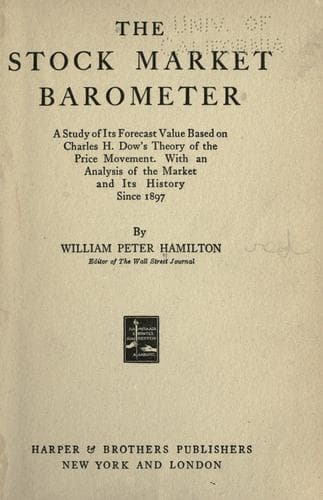
That matters, because it means there is no single authoritative statement of it. What we have is S. A. Nelson's 1902 book, which first collected the editorials and coined the name, and William Peter Hamilton's 1922 book, written by Dow's successor at the Journal, which turned the observations into a system. Both are out of copyright and hosted on this site.
Three trends running at the same time
Dow's central image was tidal. A tide runs for months or years; waves run against it for weeks; ripples come and go by the hour. All three are happening at once, and confusing one for another is how people get hurt.
The three trends running at once
| Trend | Typical length | What it is |
|---|---|---|
| Primary | A year or more | The main direction. What a long-term investor cares about. |
| Secondary | Three weeks to three months | A reaction against the primary trend, usually retracing a third to two-thirds of it. |
| Minor | Days | Noise. Dow considered it essentially unforecastable. |
The practical warning is that a secondary reaction feels exactly like a primary reversal while you are inside it. A two-thirds retracement of a year-long advance is brutal to sit through, and it is not a trend change.
The three phases
Dow's second idea was that a primary trend is not uniform. It passes through phases defined by who is doing the buying.
The three phases of a primary trend
- 1Accumulation. The news is still bad and most people are not interested. Informed buyers take stock from discouraged holders. Prices go almost nowhere, which is precisely why nobody notices.
- 2Public participation. The trend becomes visible, earnings improve, and the wider market joins. This is the longest phase and where most of the move happens.
- 3Distribution. The news is uniformly good, everyone is confident, and the people who bought during accumulation are selling into that confidence.
The rules that make it a method
- The averages discount everything. Every known fact, hope and fear is already in the price. You are not competing with the news; you are competing with everyone else's reading of it.
- Volume confirms the trend. Volume should expand in the direction of the primary trend and dry up on reactions. A rally on thinning volume is suspect.
- One average must confirm the other. Dow watched the industrial and rail averages. A new high in one, unmatched by the other, was not a signal.
- A trend is assumed to continue until there is clear evidence of reversal. The burden of proof is on the reversal, not the trend.
The confirmation rule is the one that made Dow Theory distinctive. His reasoning was economic rather than statistical: if factories are genuinely producing more, the railways carrying the goods must eventually show it too. A rise in one without the other described a story that did not add up.
What it gets wrong, and what it still gets right
Dow Theory signals late. By the time a primary reversal is confirmed under its rules, a substantial part of the move has already happened. Practitioners have always known this; it is a framework for understanding what kind of market you are in, not for catching turns.
It is also built on an economy that no longer exists. The industrial-and-rail confirmation made sense when goods moved by rail. It transfers awkwardly to a service economy, and not at all to a market with one index.
What survives is the part that was never about railways: that trends exist at multiple scales at once, that volume should agree with price, that the crowd is most confident at the worst moment, and that a single indicator agreeing with itself proves nothing. Every framework on this page inherits something from that.
How much weight it can carry
It is the most durable framework here, and its primary sources are out of copyright — you can read them on this site rather than take anyone's summary. Its weakness is that it was written for a market with separate industrial and rail averages, and its confirmation rule does not transfer cleanly to markets that lack them. It also tells you a trend has turned well after it turned; it is a framework for understanding, not a timing system.
Classical. Long established, and its primary source is out of copyright — you can read the original here rather than take a summary on trust.
On NEPSE specifically
Nepal has one exchange, so Dow's two-average confirmation cannot be applied literally. The nearest equivalent is checking whether the NEPSE index and the relevant sub-index — banking, hydropower, microfinance — are moving together, and treating a move in one alone as unconfirmed.
Read the source
Rather than take our summary on trust, check it against what the author wrote.

The vocabulary
The 8 terms you need to follow any discussion of this method.
- Dow Theory
- The oldest framework in technical analysis: markets move in primary, secondary and minor trends, and a trend is confirmed only when more than one index agrees.
- Primary trend
- The main tide of the market under Dow Theory, lasting a year or more. Secondary reactions run against it; minor moves are noise.
- Secondary reaction
- A counter-move against the primary trend under Dow Theory, typically retracing a third to two-thirds of the preceding move.
- Confirmation
- Dow Theory's requirement that a signal in one index be matched by another before it is trusted.
- Accumulation
- The phase where informed buyers build positions quietly while sentiment is still poor and prices go nowhere.
- Distribution
- The phase where informed holders sell into strength and enthusiasm, while prices look strong but stop advancing.
- Volume confirmation
- The Dow Theory principle that volume should expand in the direction of the primary trend. A rally on falling volume is suspect.
- Trend
- The prevailing direction of price over time. An uptrend makes higher highs and higher lows; a downtrend the reverse.
What the research says
We found no papers testing this method. Searching arXiv’s quantitative-finance archive for it returns nothing. That does not prove the method does not work — but it does mean nobody has published a test of it there, and you should weigh it accordingly. By contrast, the indicators page lists a dozen.